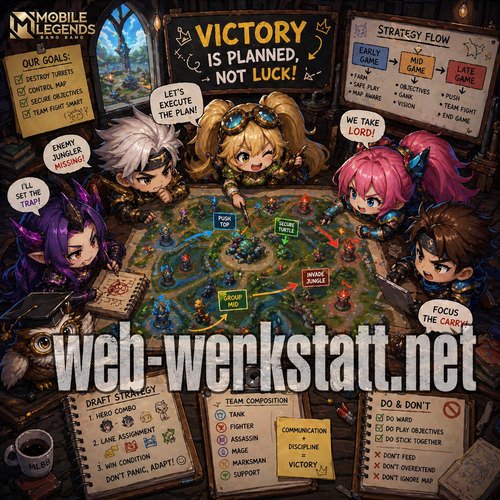
web-werkstatt.net – Securing Turtle or Lord in Mobile Legends is an important achievement, but taking the objective itself is only one part of the process. Many matches are lost because a team successfully secures an objective and then immediately returns to ordinary farming without converting the advantage into meaningful map pressure. An objective should change what the team does next. After Turtle, the team may have stronger resources and better opportunities to contest lanes, invade selected areas, or prepare the next rotation. After Lord, the situation becomes even more important because the enhanced push can create a window for attacking enemy structures. However, simply grouping in one lane and walking forward is not always the correct response. Players need to understand the condition of the map, the location of enemy heroes, the status of minion waves, and the health and cooldowns of their own team. The best post-objective decision is usually the action that makes the enemy respond to a problem they cannot easily ignore. This could mean pushing a prepared lane, synchronizing waves, controlling another part of the map, taking safe resources, or resetting before the next major engagement. The team also needs to avoid a common mistake: assuming that winning the objective automatically means winning the next fight. A team can secure Lord and still lose several heroes immediately afterward if players become too aggressive or separate from one another. The objective provides an opportunity, not a guarantee. Players should use the temporary advantage to improve their position rather than treating it as permission to take every possible fight. Understanding what happens after an objective is especially valuable because these moments often determine whether a small advantage becomes a larger one. A Turtle can provide resources that help certain heroes reach important item timings, but that advantage only matters if the team uses its improved strength effectively. Lord can pressure enemy structures, but the push becomes much stronger when lanes are prepared before the siege begins. Good post-objective gameplay therefore combines macro awareness, wave management, resource protection, and disciplined movement. Players should constantly ask what the enemy is forced to defend, which areas are safe to occupy, and what action creates the most pressure with the least unnecessary risk. Once this mindset becomes familiar, objective fights stop being isolated events. They become part of a continuous game plan in which every successful objective creates the conditions for the next advantage.
Turning an Objective Win Into Immediate Map Value
The first mistake after securing Turtle or Lord is moving immediately without checking the current state of the map. The team may have spent several abilities, lost health, or revealed its location while taking the objective. Enemy heroes may also be positioned differently from where they were before the fight. Players should therefore take a short moment to reassess before choosing the next action. Look at which enemy heroes are visible, which lanes are pushed, which structures remain vulnerable, and where the team’s members are located. This information determines whether the team should attack, reset, or reposition. If several enemies are dead or forced away, the team may have a strong temporary window to take a structure or invade a safe area. If most opponents are alive and the team’s health is low, continuing forward may be unnecessarily dangerous. Players should also consider the condition of the minion waves. A Lord push becomes much more effective when lanes are prepared, while a poorly positioned wave can delay the siege and give the enemy time to recover. After Turtle, the team may have more flexibility because there is usually less immediate pressure to end the game. That makes the post-objective period useful for improving lane assignments, collecting resources, and preparing for the next contest. Players should avoid treating every objective as a command to fight again. Sometimes the best move is simply to reset and return with full health and available cooldowns. This is particularly important for heroes whose abilities were heavily used during the objective fight. The team should evaluate whether its current strength is temporary or sustainable. If the strongest members are low on resources, a reset may preserve the advantage. If everyone is healthy and the enemy is scattered, immediate pressure may be appropriate. The important principle is that the objective changes the game state, so the next decision should be based on that new state rather than following the plan that existed before the objective. Strong players learn to pause mentally after the objective and ask what has changed. That short reassessment can prevent many unnecessary deaths and make the team’s next movement much more purposeful.
Push the Lane That Can Create the Most Pressure
After securing an objective, players should identify which lane provides the best opportunity for continued pressure. The answer is not always the lane closest to the objective. A lane with a healthy enemy structure may offer less immediate value than another lane where the minion wave is already positioned favorably. Players should examine the state of each lane and determine where the enemy is most likely to struggle. If one lane has a large friendly wave approaching an exposed turret, sending a hero there can force an enemy response. At the same time, the remaining team members can control central areas or prepare another wave. This creates multiple problems for the opponent without requiring everyone to stand together. After Lord, lane synchronization becomes especially important because the enhanced minion wave can apply pressure while heroes create additional threats. Players should avoid sending every teammate to the same lane if another lane can safely advance. The enemy should be forced to decide where to allocate its defenders. This is one of the most valuable consequences of an objective advantage: it reduces the opponent’s ability to respond everywhere at once. However, players should not overextend simply to make every lane move forward. A side lane can be pushed only as far as the player can safely retreat if enemies disappear. The team should maintain awareness of enemy rotations and avoid sending fragile heroes deep into areas without information. Lane pressure is valuable because it creates choices for the opponent, not because every wave must reach the enemy base immediately. After Turtle, a prepared side lane can also provide pressure that makes the next objective easier to approach. If an enemy hero must remain in a side lane to clear waves, fewer opponents may be available around the next major contest. This demonstrates how post-objective planning connects one event to another. The team is not simply pushing because it won the previous fight. It is shaping the map so that the next fight becomes easier to manage. Players should therefore judge lanes by their ability to force responses, preserve safety, and create future opportunities.
Do Not Chase Enemies Without a Clear Reward
Winning an objective fight can create excitement, and that often causes players to chase retreating enemies too far. A low-health opponent may look like an easy elimination, but pursuing that hero can pull the team away from valuable objectives and structures. The enemy may also be leading the chasing players into an area where their surviving teammates are waiting. Players should therefore ask what they gain by continuing the chase. If the enemy is already forced away from an important area, that may be enough. The team can instead use the time to push a wave, secure vision, collect resources, or position for the next objective. A kill is valuable, but it is not automatically more valuable than map control. After Lord, chasing a single enemy toward the jungle may allow the remaining opponents to clear the Lord wave or defend a structure. The team may lose more value than it gains. Similarly, after Turtle, chasing too deeply can cause the team to arrive late to lanes that need attention. Players should recognize the difference between a fight that naturally continues and a chase that is no longer connected to a strategic goal. If an enemy is trapped and eliminating them directly improves the next action, the pursuit may make sense. If the enemy is simply running away while the team has better objectives available, stopping the chase is often more efficient. This discipline becomes increasingly important in late-game situations, where one unnecessary death can reverse the entire advantage. Players should also remember that enemies may intentionally appear weak to bait an overextension. A disciplined team does not allow one low-health hero to determine its entire movement. Instead, it maintains formation and asks where the rest of the enemy team could be. The strongest post-objective teams are often those that recognize when they have already gained enough. They do not need to convert every advantage into another kill. They convert it into structures, resources, safer positioning, and control of the next important area.
Using the Post-Turtle Window Effectively
Turtle-related advantages are most useful when they improve the team’s ability to control the next phase of the match. After securing Turtle, players should think beyond the immediate reward and consider how the additional resources affect upcoming power spikes. A hero approaching an important item timing may now have enough resources to reach that point sooner. Another teammate may use the opportunity to stabilize a difficult lane. The team can then distribute waves more intelligently instead of allowing everyone to farm the same area. Players should also consider the next major objective and how much time remains before it becomes relevant. If the team has several minutes, this can be a useful period for clearing waves, establishing safer routes, and taking available resources. If the next contest is approaching quickly, unnecessary side pressure may be less valuable than resetting and arriving together. This is where post-Turtle planning differs from simply continuing to farm. Every action should prepare the team for a stronger future position. For example, a jungler may prioritize efficient resources while teammates maintain lane pressure. A support can help secure information around an important entrance rather than spending time chasing an isolated enemy. A side laner can push a wave and then retreat before becoming vulnerable. These actions may look small individually, but together they create a more stable map. Players should also avoid assuming that the enemy must immediately contest everything after Turtle. The opponent may instead look for their own farming opportunity. If the enemy is busy recovering, the team can safely claim additional value without forcing a fight. The goal is to use the Turtle advantage to improve resource distribution and map positioning. When players consistently connect objective rewards to future timing, they become less dependent on constant combat. They understand that an objective creates a temporary economic and positional advantage, and that advantage becomes more meaningful when it leads to better preparation for the next important moment.
Use the Enemy’s Forced Movement to Control Another Area
One of the strongest effects of winning an objective is that the enemy may be forced to respond to the resulting pressure. This creates opportunities in areas that are not directly connected to the objective itself. If a side lane begins pushing toward a structure, an enemy may have to move there to clear it. That movement can temporarily reduce the number of defenders available elsewhere. The team can then use the opening to secure vision, collect resources, or prepare another lane. This is especially useful after Lord, when the enemy may be forced to divide attention between multiple advancing waves. Players should recognize that the objective itself does not need to be the only source of pressure. The threat it creates changes enemy movement, and that movement can be exploited. A team should therefore avoid becoming predictable. If everyone always follows the Lord into the same lane, the enemy can concentrate its defense there. A better approach may involve one or two heroes creating pressure elsewhere while the main group maintains enough presence to support the Lord push. The exact arrangement depends on hero mobility and enemy composition, but the principle remains consistent: make the enemy choose. Players should also watch for defenders leaving their base or high-ground position. When an enemy hero moves away to clear a side wave, the remaining defenders may become vulnerable to pressure from another direction. However, this opportunity must be evaluated carefully. If the side-lane player is extremely mobile and can return quickly, the advantage may be small. If the defender is slow and the wave requires immediate attention, the window may be larger. Understanding these movement patterns allows players to turn an objective into a broader map-control tool. The team is effectively using one threat to create another. This is a more advanced form of macro gameplay because the goal is not simply to attack what is in front of you. It is to influence where the enemy must stand and then take value from the space they leave behind.
Prepare the Next Objective While Maintaining Pressure
Good post-Turtle play should naturally lead into preparation for the next important contest. Players should not wait until the objective appears before thinking about positioning. Lane waves, resource availability, health, and enemy locations all affect how easily the team can reach the next area. After securing Turtle, players can use the following period to improve wave positions and reset their resources. A side lane should ideally be managed so that it does not become a major problem immediately before the next objective. At the same time, the team should avoid pushing so deeply that players become trapped when the objective becomes available. This balance is one of the most difficult parts of macro gameplay. A lane that is too far forward can demand attention at the worst possible moment, while a neglected lane can allow the enemy to gain free pressure. Players should also decide who needs to remain in which area. The jungler generally needs to maintain access to relevant resources, while other heroes can take waves according to their power spikes and mobility. Supports can help create safer movement routes. The team should also remember that the enemy is preparing at the same time. If opponents disappear from the map, they may be resetting for the next contest or setting up their own pressure. Players should therefore avoid assuming that their previous objective win guarantees the next one. Every new objective is a fresh contest that requires preparation. Strong teams use the period between objectives to make the next engagement easier rather than simply waiting for the timer. This may involve pushing a wave, recalling at the correct time, taking safe resources, or controlling important entrances. The objective becomes more valuable when the team arrives with full resources and favorable lane conditions. Players who consistently prepare early often find that they do not need dramatic plays to maintain control. Their advantage comes from arriving first, occupying useful positions, and forcing the enemy to respond under pressure.
Synchronize Minion Waves Before the Siege
Lord becomes far more dangerous when its pressure is supported by well-positioned minion waves. Players should therefore think about wave synchronization before simply walking toward the enemy base. If one lane has no friendly wave while another lane is already approaching a structure, the enemy may be able to focus its defense. A synchronized push forces defenders to make more difficult choices. The team does not necessarily need perfect timing, but it should aim to make multiple lanes require attention within a similar window. Side-lane players can prepare waves before regrouping, while the central group maintains control over important areas. The exact method depends on the match state and hero mobility, but the principle is straightforward: the enemy should not be allowed to eliminate every source of pressure one at a time. Players should also understand when to stop pushing a side lane. A wave that has reached a dangerous position can be valuable, but the hero controlling it must return in time to participate in the main siege if needed. Overextending the side lane can create a numerical disadvantage. This is why wave preparation should happen before the final approach rather than during the siege itself. Once Lord begins applying pressure, the team can focus on exploiting the enemy’s defensive choices. If opponents gather in one lane, another lane may become vulnerable. If the enemy spreads out, the team may have an opportunity to engage an isolated defender. The goal is to make the Lord’s presence multiply the team’s options. Players should also avoid attacking structures blindly. The Lord provides pressure, but the team still needs to respect enemy crowd control and burst. A poorly positioned hero can give the defenders an easy pick, allowing them to survive the siege. Strong Lord usage therefore combines wave management with controlled positioning. The enhanced wave creates the opportunity, while the players must decide how to turn that opportunity into structures and map control.
Maintain Formation During the Siege
A Lord push can fail when players become too separated. One hero may move far ahead, another may chase an enemy, while the damage dealers remain behind. This gives the defenders an opportunity to isolate and eliminate individual attackers. Maintaining formation is therefore critical. The frontline should create enough space for the damage dealers to attack while avoiding unnecessary dives into the enemy base. Backline heroes should remain close enough to contribute damage but far enough away from crowd control. Players should also pay attention to which enemy abilities are still available. A high-ground defense often relies on strong area control, so walking directly into a narrow entrance can be dangerous. The team may need to wait for certain abilities to be used before committing more aggressively. Patience is particularly important because Lord pressure naturally creates urgency for the defending team. The enemy may make mistakes because it feels forced to clear waves quickly. The attacking team should take advantage of those mistakes rather than forcing the issue itself. If a defender steps too far forward, the team can punish the positioning. If the enemy stays safely under the structure, the team can continue applying pressure and wait for another opening. Formation also helps prevent counterattacks. If the enemy suddenly engages, teammates are close enough to respond. Players should avoid entering the base one by one simply because a structure appears low. The objective of the push is to create controlled pressure, not to chase the fastest possible destruction at any cost. Once a structure falls, the team should immediately reassess whether to continue, reset, or shift to another lane. This prevents momentum from becoming overconfidence. A well-managed Lord push often feels slow from the attacker’s perspective because the team is constantly waiting for safe openings. That patience is valuable. Structures can be taken through repeated pressure, but deaths can give the enemy the time it needs to recover.
Know When to End the Siege and Reset
Not every Lord push should continue until the enemy base is destroyed. Sometimes the team has gained enough value from the siege and should retreat before the defenders find an opening. Players should monitor health, cooldowns, minion position, and enemy respawn timing. If several teammates are low on health and the enemy has all major defensive abilities available, continuing to dive may create unnecessary risk. A controlled retreat can preserve the remaining advantage and allow the team to prepare for another push. This is particularly important when the enemy has already lost outer structures but still has strong high-ground defense. The team may need to reset, collect resources, and return with another wave rather than forcing an unfavorable engagement. Players should also consider what the enemy has available after the Lord expires. If the team can take a structure and then retreat safely, that may be a successful conversion even if the base remains intact. The value of Lord is not measured only by whether it ends the match. It can remove structures, force defensive cooldowns, damage the enemy economy, and create better conditions for future objectives. Players should therefore avoid treating the end of the Lord siege as a failure simply because the base survives. The important question is whether the team improved its overall position. A reset after successful pressure can be extremely powerful because the enemy may still be recovering from the previous siege. The team can use that time to fix lane assignments, recover health, and secure resources. If another major objective is approaching, resetting early may be even more valuable. Strong teams understand that pressure must eventually cycle back into preparation. Attack, force a response, secure value, reset, and prepare the next pressure cycle. This prevents the common mistake of continuing forward until someone makes a fatal error. Lord gives the team a powerful opportunity, but disciplined decision-making determines how much value is actually extracted from it.
Conclusion Mobile Legends Post-Objective Guide: What to Do After Taking Turtle or Lord
Taking Turtle or Lord in Mobile Legends should never be viewed as the end of a successful play. The objective is the beginning of a new phase in which the team must convert its advantage into map control, resources, structures, and better preparation for the next major event. Immediately after securing an objective, players should reassess the map instead of moving automatically. Enemy positions, lane conditions, health, cooldowns, and structure status all determine what the next action should be. A prepared lane can create pressure, while chasing a retreating enemy without a clear reward can waste the temporary advantage. After Turtle, the team can use its improved resources to stabilize lanes, reach item timings, and prepare the map for the next contest. Enemy movement can also be exploited because opponents forced to respond to one lane may leave another area temporarily vulnerable. This creates opportunities for safe resource collection and map control without requiring constant fighting. Preparation for the next objective should begin early, with players managing waves and resetting resources before the next contest rather than waiting until the final moment. Lord requires even more deliberate planning. Synchronizing minion waves can force the enemy to defend multiple areas, while maintaining formation prevents the defending team from easily isolating individual attackers. Players should remain patient during the siege and take structures when safe opportunities appear rather than diving recklessly simply because the Lord is present. Knowing when to end the siege is equally important. A team that takes a structure and retreats safely may gain more long-term value than a team that continues fighting and loses several heroes under the enemy’s base. The central lesson is that objectives create opportunities, but they do not make decisions automatically. Turtle and Lord provide temporary advantages that must be translated into smart movement. Every post-objective action should have a purpose: pushing a useful wave, forcing an enemy response, collecting safe resources, preparing the next contest, damaging structures, or resetting for another pressure cycle. Players who learn to think this way will stop treating objectives as isolated battles and begin seeing them as connected parts of the match’s larger flow. The strongest post-objective gameplay is not necessarily the most aggressive. It is the gameplay that consistently extracts value while keeping the team in a position to make the next decision with confidence. By combining wave management, formation, resource awareness, enemy tracking, and disciplined resets, players can transform a single Turtle or Lord into sustained pressure that changes the entire map.