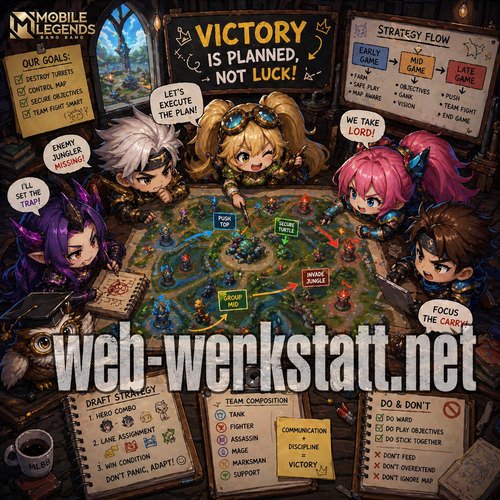
web-werkstatt.net – Not every Mobile Legends match gives a player the opportunity to become the strongest member of the team. Sometimes a hero has a slow power curve, falls behind after losing an early trade, requires several items before becoming effective, or simply struggles against the enemy composition. In these situations, trying to play as though the hero is already powerful can create even more problems. A player who is behind may force fights, compete for resources that teammates need more urgently, or repeatedly enter situations where the hero has little chance of succeeding. The result is often a larger deficit that affects the entire team. Playing effectively while being the weakest member of the team requires a different mindset. Instead of trying to prove that the hero can suddenly dominate, the player should focus on reducing weaknesses, providing useful contributions, and creating opportunities for stronger teammates.
Being the weakest player in a particular match does not mean being useless. Mobile Legends is built around different forms of value, and damage is only one of them. A hero with low gold can still provide crowd control, vision, protection, wave clearing, zoning, initiation, or distraction. A player who recognizes these possibilities can remain useful even without a large item advantage. The key is to understand what the team currently needs and what the hero can realistically provide. If the hero cannot win a direct duel, there may be no reason to take one. If the hero cannot safely farm in an advanced position, resources should be collected from safer areas. If a teammate has become the team’s main carry, supporting that teammate may create more value than trying to rebuild personal dominance.
Playing from a weak position is therefore not simply about surviving until the match ends. It is about changing the way you measure success. A good performance from a weak position may involve preventing additional deaths, protecting a stronger teammate, clearing dangerous waves, absorbing enemy attention, or making one well-timed play that changes an important fight. The player who accepts the current weakness and adapts accordingly can often become more valuable than a player who refuses to acknowledge it.
Understanding Your Hero’s Temporary Weakness
The first step toward playing effectively from a weak position is identifying the difference between feeling weak and actually being weak. A player may lose one trade and immediately assume that the lane is impossible, even though the hero remains capable of recovering. On the other hand, a player may have a few kills but still be weaker than the enemy because of lost farm, poor item timing, or an unfavorable matchup. Proper evaluation requires looking at the entire situation rather than one statistic.
Compare your level, items, gold income, available skills, and recent combat results with the opponent you are expected to face. Also consider whether your hero naturally becomes stronger later. Some heroes are designed to dominate early, while others become significantly more useful after completing several items. A temporary disadvantage is not automatically a disaster if the hero’s expected power curve remains favorable.
The most important question is whether you can realistically win the next direct interaction. If the answer is uncertain, avoid treating the matchup as a guaranteed opportunity. A player who is slightly behind may still win through positioning, cooldown management, or teammate assistance. But if the enemy has a major level and item advantage, repeatedly challenging them without support simply gives the opponent more opportunities to increase the lead.
Recognizing weakness early is valuable because it allows you to change your behavior before the deficit becomes severe. Instead of waiting until the hero is far behind, you can already begin taking safer routes, prioritizing guaranteed resources, and choosing fights carefully. The goal is not to become afraid of the enemy. It is to stop giving the enemy easy opportunities to exploit your current disadvantage.
Separate Your Hero’s Weakness From Your Team’s Needs
A hero can be weak individually while still being important to the team. This distinction is easy to miss when looking at personal statistics. A player may have low damage but provide reliable crowd control. A player may have few kills but protect a valuable carry. Another hero may be behind in gold but have abilities that remain useful regardless of item disadvantage.
Instead of asking how to make your own scoreboard look better, consider what your team is currently missing. If another teammate is already dealing most of the team’s damage, your job may be to protect that hero. If the team lacks initiation, your utility may be more important than your personal damage. If the team struggles to defend structures, wave clearing may become your primary responsibility.
This approach prevents a weak player from competing with stronger teammates for the same resources. If a teammate is already ahead and can carry fights with additional gold, giving that teammate priority may produce more value than taking resources you need only to become moderately stronger.
A weak position therefore does not necessarily mean a passive role. It means your contribution must be chosen more carefully. You can still move aggressively when the situation supports it, but your actions should be based on what your hero can realistically accomplish rather than what you wish it could accomplish.
Identify Your Next Realistic Power Point
Playing from behind becomes much easier when you have a clear idea of what you are waiting for. Your next power point could be a completed item, a level threshold, an ultimate upgrade, a defensive purchase, or simply a moment when the enemy’s key ability is unavailable. Without a specific target, players often wander between farming and fighting without a clear purpose.
Suppose your hero becomes significantly more useful after completing one defensive item. In that case, surviving safely until the purchase may be more valuable than forcing several risky fights for small amounts of gold. If your ultimate creates a major teamfight opportunity, preserving it for an important objective may be better than using it on a low-value encounter.
A power point also gives you a reason to avoid unnecessary frustration. You may not be strong now, but you know what you are building toward. This creates patience without requiring passivity. You continue collecting resources, supporting teammates, and looking for favorable opportunities while avoiding situations that your current power level cannot handle.
The important thing is to keep the goal realistic. Do not assume that one item will suddenly make an extremely difficult matchup easy. Instead, identify the improvement that will allow you to perform your role more effectively. A good power point does not need to transform your hero into the strongest character on the map. It only needs to make your next useful action more reliable.
Contributing Without Becoming a Liability
When a hero is behind, resources become important, but the method used to collect them matters just as much. A weak player often feels pressure to recover quickly and may start taking dangerous waves or entering enemy-controlled areas. This can lead to another death, which makes recovery even harder.
Safe farming is therefore a strategic skill. Learn which waves can be collected without exposing yourself, which jungle resources are reasonably safe, and when you should leave an area because too many enemies are missing. A smaller guaranteed income is often better than a larger theoretical income that requires constant risk.
This does not mean refusing all contested resources. If your team has clear information and support nearby, you can sometimes take resources that would otherwise be dangerous. The key is to match the risk to the value. A small amount of gold is rarely worth dying for, especially when your death can create additional pressure against your teammates.
You should also avoid taking resources simply because they are available. If a stronger teammate needs a particular resource to complete an important item, allow that player to receive priority when possible. Your own recovery is important, but the team may recover faster if the strongest hero becomes even stronger while you stabilize your position.
Become Difficult to Punish
One of the most useful things a weak player can do is become difficult for the enemy to exploit. If the enemy cannot repeatedly kill you, their advantage becomes less meaningful. This requires better positioning, awareness of missing enemies, and discipline around enemy cooldowns.
Avoid standing in areas where multiple opponents can reach you simultaneously. Do not push a side lane too far when the enemy’s key heroes are missing. Be careful when entering bushes or contested jungle areas without information. These habits may seem defensive, but they can dramatically reduce the value of the enemy’s lead.
A player who is behind should also understand that retreating early is not necessarily failure. If the enemy has a stronger position and you recognize the danger before the fight begins, leaving can be the correct decision. You preserve your life, protect your resources, and prevent the enemy from converting a small advantage into a larger one.
Over time, this discipline can frustrate opponents. They may have a stronger hero but still fail to obtain additional kills. Eventually, their attention may shift toward another target, giving you more room to recover. Survival is not the entire strategy, but it is often the foundation that makes recovery possible.
Use Utility to Help Stronger Teammates
When your hero cannot carry through damage, utility can become your primary source of value. Crowd control, protection, zoning, vision, and timing can all influence fights even when your item count is low.
A weak support, for example, may not eliminate an enemy damage dealer but can prevent that hero from reaching your team’s carry. A behind fighter may not win a duel but can interrupt an enemy’s approach. A struggling mage may not burst opponents but can use abilities to control an important area before an objective fight.
This requires understanding that your role is not necessarily determined by the scoreboard. A low-damage contribution can still be extremely valuable if it creates the conditions for another teammate to deal damage safely. In some situations, your most successful play may involve sacrificing your own positioning to protect a more important hero, although this should not become an excuse for careless deaths.
The best way to use utility is to identify your team’s most important win condition. If one teammate is clearly capable of carrying fights, make it harder for enemies to reach them. If your team needs time to scale, create space and avoid unnecessary engagements. If an objective is approaching, use your abilities to control the area rather than wasting them on random targets.
Look for Small Advantages Instead of One Huge Comeback
Players who are behind often make the mistake of searching for one massive fight that will instantly fix everything. This mindset can create unnecessary risks. A better approach is to collect several small advantages that gradually reduce the deficit.
A successful wave clear, a safe jungle camp, an enemy recall, a missed enemy ability, or a teammate winning a trade can all contribute to recovery. None of these events may look dramatic, but together they can change the game’s direction. The important part is recognizing them and using them efficiently.
If an enemy leaves a lane to recall, that may create time to collect a wave. If an opponent wastes a major ability, your team may have a temporary opportunity to pressure them. If the enemy group moves toward one side, your team may be able to safely collect resources on the opposite side. These small moments become especially valuable when your hero is waiting for a larger power spike.
Comebacks are usually built from repeated improvements rather than one miraculous play. By focusing on manageable advantages, a weak player reduces the chance of making another catastrophic mistake.
Support the Strongest Teammate During Critical Moments
When your own hero is behind, the strongest teammate becomes even more important. Instead of trying to become the team’s main carry immediately, look for ways to make that player’s job easier.
This may mean protecting their retreat, providing crowd control against their target, clearing a dangerous lane before they rotate, or helping establish control around an objective. Your teammate’s success can indirectly accelerate your own recovery because a successful team fight may provide resources and map space for everyone.
Communication becomes especially useful here. If you know that your strongest teammate is preparing to make a play, avoid creating unnecessary pressure elsewhere that forces them to choose between several emergencies. When possible, synchronize your movement with the team’s strongest threat.
A weak hero can therefore have a major impact simply by increasing the effectiveness of someone else. Team games reward complementary strength. You do not need five powerful heroes to win; you need your available strengths to work together effectively.
Recognize When Your Role Has Changed Again
Being the weakest hero does not necessarily remain true for the entire match. Once you complete important items, recover several waves, or survive through a difficult phase, your role may change. A player who spends too long behaving as though they are permanently weak may miss opportunities after finally becoming strong enough to participate more actively.
This is why adaptation must continue throughout the match. Reevaluate your hero after major purchases, levels, or changes in enemy positioning. If you now have enough durability to survive an engagement, you can take more space. If your damage has become meaningful, you may begin threatening targets that were previously too difficult. If your utility remains your strongest asset, continue prioritizing it.
The objective is not to remain defensive forever. The objective is to play according to your current strength. Good players can shift from survival to pressure as soon as the situation allows it.
Conclusion Mobile Legends Guide: How to Play Effectively When Your Hero Is the Weakest Link
Playing as the weakest hero on a Mobile Legends team requires patience, awareness, and a willingness to redefine what useful gameplay means. A player who is behind should not try to imitate the behavior of a fed hero. Instead, the focus should be on identifying realistic power points, collecting safe resources, avoiding unnecessary deaths, and contributing through whatever utility the hero can still provide.
A weak position becomes especially manageable when the player stops measuring success only through kills and damage. Protecting a strong teammate, clearing a dangerous wave, denying an enemy opportunity, controlling an objective area, or simply surviving a difficult phase can all create meaningful value. These actions may not always appear impressive on the scoreboard, but they can prevent the enemy from turning an advantage into a decisive lead.
Most importantly, being weak at one moment does not mean remaining weak for the entire match. Mobile Legends is constantly changing. Items are completed, heroes gain levels, enemies make mistakes, and opportunities appear unexpectedly. By minimizing losses while preparing for the next power point, a struggling player can gradually become useful again. The best response to being the weakest member of the team is not panic or reckless aggression, but controlled adaptation. When that mindset is combined with smart resource management and strong teamwork, even a difficult early position can become the beginning of a successful comeback.