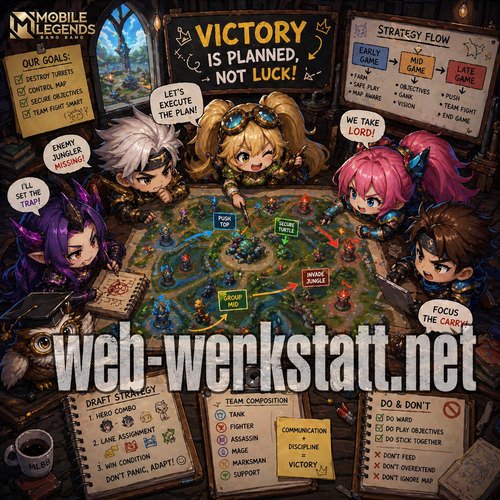
web-werkstatt.net – Mobile Legends is not always won by the team that gets the most kills. In many matches, the deciding factor is how effectively a team controls lanes and forces the enemy to respond to multiple threats at the same time. One of the most useful strategies for creating this kind of pressure is split pushing. Although the concept sounds simple, effective split pushing requires much more than standing in a side lane and attacking a turret. Players need to understand minion waves, enemy positions, rotation timing, hero strengths, escape routes, and the relationship between side-lane pressure and objectives elsewhere on the map.
A player who split pushes without awareness can easily become an easy target. On the other hand, a player who understands how to manipulate side lanes can force several enemies to change their plans, create openings for teammates, and gradually weaken the opponent’s ability to defend important areas. This is why split pushing should not be viewed as playing alone. It is a coordinated form of map pressure in which one player’s position influences the decisions available to the entire enemy team.
Side-lane gameplay also teaches an important lesson about patience. Sometimes the correct move is not to join a fight immediately. A player may gain more value by pushing a wave, forcing an opponent to reveal themselves, and then rotating toward the rest of the team. At other times, remaining in the side lane is dangerous because an objective is about to become available and the team needs every member nearby. Knowing the difference requires awareness rather than a fixed rule.
Building Effective Side Lane Pressure
Minion waves are the foundation of successful side-lane pressure. A player who understands how waves move can create opportunities without constantly fighting the enemy hero. The first objective is usually to clear waves efficiently while avoiding unnecessary exposure.
When a wave is pushed toward the enemy side, the opposing player must eventually respond if they do not want their turret to take damage. This creates a strategic choice. The enemy can remain with their team and risk losing lane resources, or they can move to the side lane and temporarily reduce their presence elsewhere. That decision is exactly what makes split pushing valuable.
However, pushing every wave as quickly as possible is not always ideal. Sometimes allowing a wave to remain closer to your side of the map gives you a safer farming position. It can also make the enemy overextend if they want to contest the wave. Players should therefore think about where they want the next encounter to happen rather than simply clearing whatever appears in front of them.
Wave timing becomes especially important before objectives. If a side lane is pushed just before the enemy team prepares for an objective, an opposing player may be forced to spend valuable seconds dealing with the minions. Even if no turret is destroyed, the pressure can delay the enemy’s rotation and create a better opportunity for your team.
A strong side-lane player constantly considers the next wave instead of only the current one. The question is not simply whether you can clear the minions, but what the resulting wave position will force the enemy to do.
Choosing the Right Hero for the Side Lane
Not every hero is equally effective at split pushing. Heroes with strong wave clear, sustained damage, mobility, durability, or the ability to escape dangerous situations often perform better in side lanes. However, the most important factor is whether the hero can create pressure without becoming an easy target.
A side-lane hero needs to understand its own limitations. A durable fighter may be able to stay in a lane longer than a fragile mage, while a highly mobile hero may escape from situations that would be fatal for another character. Some heroes can threaten structures quickly but struggle when multiple enemies arrive. Others may not destroy turrets particularly fast but can keep a lane occupied for a long period.
Players should therefore avoid choosing a side-lane strategy solely because a hero has good damage. Survival and mobility are often just as important. A hero that destroys a turret quickly but dies immediately afterward may provide less value than a hero that pushes more slowly but repeatedly forces enemies to respond.
The enemy composition should also influence the decision. If the opposing team has several heroes capable of quickly reaching side lanes, split pushing becomes more dangerous. If the enemy lacks reliable ways to catch a mobile side-laner, that weakness can be exploited.
Understanding these differences helps players decide whether they should pressure aggressively, push cautiously, or remain closer to the team.
Creating Pressure Without Overextending
One of the biggest mistakes in side-lane gameplay is confusing pressure with unnecessary risk. Players sometimes continue pushing because they believe they must reach the turret at all costs. This can result in an avoidable death that removes the pressure entirely.
Good split pushing is based on information. If several enemy heroes are visible on the opposite side of the map, pushing becomes safer. If multiple enemies suddenly disappear, the player should become more cautious. A missing enemy does not guarantee that they are coming toward the side lane, but it increases the possibility.
Players should also establish an escape route before advancing too far. Knowing which jungle entrance, river path, or nearby structure can be used for retreat is extremely valuable. A side laner should avoid moving into a position where every escape path is blocked.
The best side-lane pressure often happens just before the player becomes truly vulnerable. Push the wave, damage the structure if safe, then retreat before the enemy can surround you. Repeating this process can force the opponent to spend more time defending than attacking.
This is an important difference between aggressive gameplay and reckless gameplay. Aggression creates problems for the enemy. Recklessness creates problems for your own team.
Combining Split Push With Team Strategy
Split pushing becomes much stronger when teammates understand how to use the pressure being created. If one player is pushing a side lane, the other four should not automatically chase the nearest enemy. Instead, they can use the enemy’s reaction to create opportunities elsewhere.
Suppose the enemy sends two heroes toward the side lane to stop the push. The remaining players may now have fewer opponents in the middle of the map. Depending on the situation, they could secure vision, pressure another lane, take a jungle resource, or prepare for an objective. The side-laner has effectively removed two enemy players from the area without needing to defeat them.
This is why communication matters. A side-laner should inform teammates when multiple enemies are missing or when they are being pressured. Teammates should understand that an enemy rotating toward the split pusher may leave another area exposed.
The strategy works in reverse as well. If the main team is applying pressure in mid lane, the side-laner may find more freedom to push because enemies are occupied elsewhere. Both parts of the team influence each other.
Players should avoid thinking of split pushing as one hero versus five. It is better understood as a map-wide interaction between two groups whose movements affect one another.
Knowing When to Join the Team
One of the most important split-push decisions is knowing when to stop pushing and join the team. Remaining in the side lane too long can turn a useful strategy into a major disadvantage.
The timing depends heavily on objectives and enemy movement. If a major objective is about to become the center of the game, being too far away may make it impossible to assist your teammates. Likewise, if the enemy team has already committed to a fight, continuing to push may not provide enough value to compensate for losing the engagement.
Players should monitor the map rather than relying on a fixed distance or timer. If the enemy team disappears and your teammates begin retreating, the side lane may no longer be safe. If the enemy sends several players toward you while your teammates have an opportunity elsewhere, staying may be correct for a short period, but only if you have a realistic chance of escaping.
Good split pushers know that joining the team is not a failure of the strategy. The purpose of split pushing is to create favorable decisions. Once the situation changes, the player must change with it.
Sometimes the best result is pushing the wave and immediately rotating. Sometimes it is forcing an enemy to remain in the side lane while your team takes an objective. Sometimes it is abandoning the lane entirely because a fight has become more important. Flexibility is what separates effective side-lane gameplay from repetitive behavior.
Turning Side Pressure Into Objectives
The ultimate purpose of lane pressure is to create access to meaningful objectives. A turret, major neutral objective, enemy jungle, or favorable team fight is generally more valuable than simply accumulating minion kills.
When a side lane is pushed successfully, the enemy may be forced to defend a structure. This can create a temporary numerical advantage elsewhere. If your team recognizes that opportunity, it can convert pressure into something tangible.
For example, if an enemy defender leaves an objective area to clear a side wave, your team may gain enough time to establish control. If two enemies move to stop a push, the rest of your team may be able to occupy another important area. The exact action depends on the game state, but the principle remains the same: use enemy movement as information.
Players should therefore look beyond the turret itself. A turret is valuable, but the enemy’s response to the turret can be even more important. If defending it requires multiple heroes, your team has gained strategic space.
This mindset encourages players to think several steps ahead. Instead of asking, “Can I destroy this turret?” ask, “What will the enemy do if I threaten this turret, and what can my teammates do while they respond?”
Split Pushing When Ahead
When your team is ahead, split pushing can make the enemy’s defensive situation extremely uncomfortable. They already have fewer resources or less map control, and forcing them to defend multiple lanes can prevent them from recovering.
However, being ahead does not mean every split push should be aggressive. A lead can disappear quickly after one unnecessary death. The side-laner should still respect enemy crowd control, mobility, and potential ambushes.
The ideal situation is to push while teammates maintain pressure somewhere else. If the enemy sends one player to defend, the side-laner can potentially win the matchup. If several enemies rotate, teammates gain more freedom elsewhere. Either way, the enemy is forced to make a difficult decision.
The team should also avoid separating so far that the side-laner cannot influence important fights. Map pressure works best when players remain close enough to respond when the situation suddenly changes.
Split Pushing While Behind
Split pushing can also be useful when a team is losing, but the purpose changes. Instead of trying to overwhelm the enemy, the goal is often to create time and force the stronger team to divide its attention.
A team that is behind may struggle in a direct five-on-five battle. Constantly forcing those fights can make the deficit worse. A side-lane strategy may provide another path by making the enemy defend waves and structures.
However, the weaker team must be especially careful about deaths. Giving the enemy another kill while already behind can accelerate their advantage. Side-lane pressure should therefore prioritize safe farming and forcing responses rather than taking unnecessary duels.
If the enemy sends multiple heroes to stop the push, the side-laner should look for an escape rather than attempting to defeat everyone. The objective is to waste enemy time and create space for teammates to recover resources.
A comeback often begins with small improvements in map control. One safely managed wave may not seem important, but repeated pressure can gradually force the stronger team to react instead of freely attacking.
Recognizing When Split Push Is the Wrong Choice
There are moments when split pushing should simply be abandoned. If your team is about to contest a decisive objective, the value of having every member nearby may be greater than the value of another side wave. If the enemy has several heroes missing and your escape options are poor, continuing to push may be too dangerous.
Players should also reconsider split pushing when the enemy has strong tools for instantly collapsing on isolated targets. A strategy that worked five minutes ago may become ineffective after the enemy completes important items or changes their rotation pattern.
The ability to stop a strategy is part of mastering it. Good players are not loyal to a particular tactic when the game no longer supports it. They adapt.
Side lanes are tools, not obligations. If the team needs grouping, group. If the enemy must defend a side lane, apply pressure. If the map becomes dangerous, retreat. The correct decision always depends on the current state of the match.
Conclusion Mastering Split Push and Side Lane Pressure in Mobile Legends
Split pushing in Mobile Legends is much more than sending one hero toward a turret while the rest of the team waits elsewhere. It is a strategic method of manipulating enemy movement, controlling minion waves, creating map pressure, and forcing difficult decisions. Successful side-lane gameplay requires patience, awareness, positioning, and an understanding of when pressure should be increased or abandoned.
Players should learn to manage waves, select appropriate heroes, monitor enemy positions, establish escape routes, and communicate with teammates. More importantly, they should understand that the side-laner and the main team are connected. When one side of the map creates pressure, the other side should look for ways to exploit the enemy’s response.
A strong split push does not always result in a destroyed turret. Sometimes its greatest value is forcing an enemy to rotate, delaying their objective setup, protecting your team from a bad fight, or creating enough space for a teammate to farm. When used intelligently, side-lane pressure can make the entire battlefield difficult for the opponent to control.
The best players know when to push, when to retreat, when to rotate, and when to group. By learning to read waves and enemy movement instead of following a rigid split-push routine, players can turn side lanes into one of the most powerful tools for controlling the pace of a Mobile Legends match.