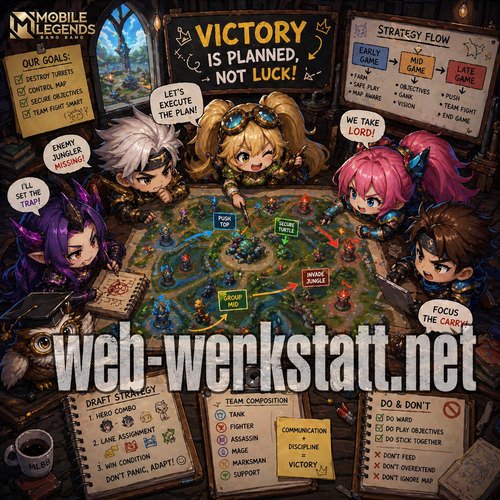
web-werkstatt.net – Mobile Legends is a team-based game in which individual mechanical skill matters, but strong coordination can have an even greater influence on how consistently a team performs. Every player enters the battlefield with a different hero, role, ability set, and responsibility, yet those individual elements only become truly effective when they work together. A marksman needs space to deal sustained damage, a tank or support often needs to create opportunities and protect teammates, a jungler must manage resources and objectives, while side-lane players frequently balance farming, pressure, and defensive responsibilities. When these roles operate independently, a team can appear powerful on paper but still struggle because its actions happen at different times. One player may initiate before teammates are ready, another may chase an enemy too far, while the damage dealers remain outside the effective range of the fight. Good team synergy solves these problems by giving every player a clearer understanding of when to act and how their decisions affect everyone else. Coordination does not necessarily require voice communication or complicated instructions. Much of it comes from recognizing patterns, reading the minimap, understanding hero capabilities, and responding to teammate movements. A player who knows when an ally is preparing an engagement can position more effectively before the fight begins. Likewise, a player who recognizes that teammates are retreating can avoid turning a lost position into an unnecessary death. Team synergy is therefore not only about executing spectacular combinations. It is also about reducing conflicting decisions and making five individual players function as one strategic unit. Learning this concept can improve gameplay across every role because it encourages players to think about the entire battlefield instead of focusing exclusively on their own lane, farm, or statistics.
Understanding Each Role and Its Responsibility
Before improving coordination, players need to understand what their chosen hero actually contributes to the team. Two heroes can occupy similar positions but have completely different purposes during a match. One may specialize in initiation, another in sustained damage, while another provides crowd control or defensive utility. Knowing these differences changes how a player approaches fights. A hero with strong initiation tools may need to create the first opening, while a fragile damage dealer should often wait until dangerous enemy abilities have already been used. A player who ignores this distinction may enter at the wrong moment and become eliminated before contributing meaningful damage. Understanding a hero also means knowing its limitations. Range, mobility, cooldowns, durability, and resource requirements all affect how safely the hero can participate in a battle. A player should not expect every teammate to follow the same positioning rules. Instead, each role should operate according to what its hero is capable of doing. This becomes particularly important when forming a team composition because individual strengths can complement one another. A durable frontline can create space for a ranged damage dealer, while crowd control can make it easier for another hero to land important abilities. However, synergy does not mean every ability must be combined perfectly. Even simple interactions can produce strong results when teammates understand their responsibilities. Players should also think about what their hero should accomplish before, during, and after a fight. Before combat, positioning and vision may be the priority. During combat, the hero may need to initiate, protect, deal damage, or disrupt. After combat, the team may need to convert the advantage into an objective, turret, or safer map position. This broader understanding prevents players from measuring success only through kills. A hero can make an important contribution without securing the final hit, and recognizing that contribution is an important step toward better team play.
Building Better Frontline and Backline Relationships
One of the clearest examples of team synergy is the relationship between frontline and backline heroes. Frontline players generally operate closer to danger, absorbing pressure, threatening enemy formations, or creating space for teammates. Backline heroes often need more distance because their survival is essential for sustained damage or utility. Problems occur when these positions become disconnected. If the frontline advances too quickly, the backline may be unable to follow safely. If the backline stays too far away, the frontline may be overwhelmed without meaningful support. Good positioning therefore depends on distance and timing rather than simply standing in a particular area. Frontline players should understand how far their teammates can realistically support them. Before initiating, they can check whether the primary damage dealers are nearby and whether important abilities are available. Backline players should similarly monitor the frontline’s movement and avoid treating every engagement as an invitation to immediately move forward. Sometimes the safest response is to maintain distance until the enemy commits important abilities. This relationship becomes even more important when the opposing team has strong dive or assassination tools. A backline hero that stands alone can become an easy target, while a protected damage dealer can continue contributing throughout an extended fight. Team synergy also involves protecting teammates without becoming overly passive. A frontline player does not always need to chase the enemy’s backline. Sometimes the most useful action is preventing enemy divers from reaching an allied marksman or mage. The correct choice depends on the fight’s structure. Players should evaluate where the greatest threat is coming from and which teammate is currently providing the most important contribution. This creates a more flexible understanding of roles. A tank or support is not simply an initiator, and a damage dealer is not simply a player who chases kills. Every role can change its priorities depending on the battlefield. When players recognize these relationships, teamfights become less chaotic because each person has a better idea of where their attention should be directed.
Creating a Team Plan Before the Fight Begins
Teamfights are often decided before the first ability is used because positioning, information, and cooldown availability can determine which team enters the battle with an advantage. A simple plan can greatly improve coordination. Players should understand where the team wants to fight, which enemy hero represents the greatest threat, and what major abilities are available. This does not require lengthy communication. Even quick signals can help teammates recognize that an engagement is being prepared. For example, a player moving toward an enemy position may be indicating an intention to pressure, but teammates should not automatically follow unless the situation supports it. Good coordination comes from recognizing whether the movement is a genuine initiation or simply an attempt to establish space. Players should also pay attention to enemy cooldowns. If a powerful defensive or initiation ability has already been used, the window for another teammate to engage may become more favorable. Conversely, if the enemy’s key abilities are ready and allied resources are unavailable, forcing a fight can create unnecessary risk. Team planning also includes identifying what happens if the engagement fails. A retreat route should be available, and players should avoid positioning themselves so far forward that one failed initiation becomes a complete team collapse. This is especially important around objectives because teams often become impatient when they believe they must fight immediately. Sometimes controlling the surrounding area and waiting for the opponent to make the first mistake is more effective than forcing an uncertain engagement. A good plan therefore includes both an action and a response. Players should know what they want to achieve, but they should also be prepared to change the plan when the enemy behaves differently. This adaptability is one of the strongest indicators of coordinated gameplay.
Improving Communication Through Movement and Timing
The minimap is one of the most important sources of information in Mobile Legends, and it can function as a form of communication even when players are not using voice chat. Every visible movement provides information about the current state of the match. When an enemy appears in one lane, teammates can immediately understand that the enemy is temporarily less likely to influence another part of the map. When several enemies disappear simultaneously, players should recognize that an ambush or rotation may be developing. This information becomes especially useful for coordinating movements. A player who sees an enemy leaving the lane can warn teammates through a signal, while another player can adjust positioning before the opponent arrives. Minimap awareness also helps players understand whether an ally is actually ready to engage. A teammate moving toward an enemy while three other allies are nearby may be preparing a coordinated play. The same movement from an isolated player may simply represent pressure or scouting. Learning to interpret these differences prevents accidental overcommitment. Players should also use the minimap to judge whether a teammate needs assistance. If an ally is being pressured on one side while the rest of the team has no immediate objective, rotating toward that player may prevent a disadvantage. However, blindly following every movement can create new problems. Rotation decisions should consider wave positions, objectives, and travel time. The goal is not to react to everything but to identify the movements that matter. Over time, players can develop a habit of checking the minimap before making major decisions. This small behavior can improve team coordination because it reduces the number of actions taken without considering the positions of both allies and enemies.
Synchronizing Abilities Instead of Using Them Independently
Hero abilities become more powerful when players understand how their effects interact. This does not mean every team needs a perfectly scripted combo. Instead, players should recognize opportunities where one ability creates conditions for another. Crowd control can give a damage dealer more time to attack, displacement can force enemies into unfavorable positions, and defensive abilities can allow an ally to survive long enough to finish an important target. Timing is critical because using abilities independently can cause teammates to miss the opportunity to combine their strengths. A player should avoid immediately spending every important ability simply because an enemy is visible. Sometimes waiting a few seconds allows another teammate to establish control first. This is especially relevant for abilities with long cooldowns. If a player uses an important ultimate on a low-priority target and the enemy’s main damage dealer appears immediately afterward, the team may have lost a valuable resource. Players should therefore distinguish between abilities that can be used frequently and abilities that should be preserved for decisive moments. Communication helps, but visual awareness can often be enough. If a teammate begins an engagement, nearby players can quickly determine whether their abilities can follow. Likewise, if the first engagement fails, teammates should avoid automatically throwing additional abilities into an already lost position. The goal is to maximize the combined value of resources. Strong coordination can make relatively simple heroes appear much more effective because their abilities are being used in a shared sequence rather than five separate actions. Players can improve this skill by reviewing their own fights and asking whether their abilities were used at the correct moment, whether they followed a teammate too early, or whether they waited too long to provide support. These questions help turn mechanical ability usage into deliberate team play.
Knowing When to Follow and When to Disengage
Following teammates is important, but blindly following every movement can be one of the fastest ways to lose control of a match. A teammate may make an aggressive decision that cannot be supported safely, and joining that action can transform one mistake into several deaths. Players should therefore evaluate whether an engagement is realistically supportable before committing. Distance, health, cooldowns, enemy numbers, and nearby terrain all matter. If an ally enters a dangerous area while several enemies are missing, the safest choice may be to retreat rather than attempt an impossible rescue. This does not mean abandoning teammates. It means understanding that preserving the remaining team can sometimes be more valuable than sacrificing additional players. Disengagement should also be coordinated. When one player begins retreating, nearby teammates should recognize the signal and avoid continuing forward without a clear reason. Many failed teamfights occur because some players retreat while others continue attacking, creating a fragmented formation that the enemy can exploit. A coordinated retreat keeps the team together and protects resources for the next opportunity. Players should also learn to distinguish between a temporary setback and a completely lost fight. If an enemy uses major abilities and the team survives, repositioning may create another opportunity seconds later. There is no requirement to continue fighting simply because combat has already started. Good teams can enter, reassess, disengage, and re-engage when conditions improve. This flexibility makes coordination more resilient. Instead of assuming that every fight must end with a kill, players learn to value survival, cooldown preservation, and positional recovery. Over many matches, this approach can significantly reduce unnecessary deaths and improve the team’s ability to maintain control.
Coordinating During the Early Game
Team synergy begins before large teamfights appear. During the early game, players should understand how their individual actions affect the team’s economy and future options. Laners need enough resources to remain relevant, junglers need efficient routes and objective awareness, and support-oriented players can influence rotations and protection. Coordination during this stage often involves small decisions rather than dramatic plays. A player can help an ally secure a safe wave, rotate when an enemy overextends, or avoid taking unnecessary resources that another teammate needs more urgently. These actions build the foundation for later team strength. Early-game coordination also means recognizing when not to fight. If an enemy has a stronger temporary position, waiting for a better opportunity can preserve health and prevent the opposing team from gaining momentum. Conversely, if several teammates have an advantage in a nearby area, moving together can turn that advantage into pressure. The important factor is synchronization. Players should avoid making major movements without checking what teammates are currently doing. A jungler rotating toward a lane while the laner is recalling creates a different situation from the same rotation while the laner is preparing to engage. These details may seem small, but they determine whether a play has enough support to succeed. Players can improve by observing the timing of their teammates rather than focusing only on their own actions. Ask whether the team is currently spread out, whether resources are available, and whether an objective is approaching. The more consistently players answer these questions, the easier it becomes to recognize when the team is ready to act together.
Adapting Team Roles During the Mid Game
The mid game often creates more complicated situations because players begin leaving their original lanes and moving across the map. The role a player performed during the first minutes may no longer describe every responsibility they have. A side-lane hero may need to join an objective fight, while a jungler may need to protect a vulnerable teammate rather than aggressively invade. This flexibility is essential because the battlefield becomes less predictable. Teams that remain attached to rigid role expectations can struggle when the match changes direction. Players should instead understand the broader purpose behind their role. A damage dealer still needs to produce damage, but may sometimes need to clear a wave before joining teammates. A tank may initiate in one situation and peel for a teammate in another. A jungler may secure an objective in one moment and provide pressure elsewhere when the objective is unavailable. These adjustments should be based on the current map state. Mid-game synergy also benefits from grouping at meaningful moments. Constantly moving as five can reduce farming efficiency, but remaining completely separated can make the team vulnerable to picks. The solution is to group around objectives and important map events while allowing players to collect resources safely when there is no immediate contest. This creates a balance between individual development and collective strength. Players should also understand that the strongest teammate is not always the player with the most kills. A player who controls waves, protects objectives, provides vision, or creates space can have enormous strategic value without appearing dominant on the scoreboard. Recognizing these contributions helps teams make better decisions about where to allocate resources and who should receive protection during important moments.
Maintaining Synergy in the Late Game
Late-game coordination requires patience because mistakes become increasingly expensive. With longer respawn timers and fewer safe areas available, teams should avoid unnecessary fights that do not lead to meaningful objectives. Positioning becomes more important, especially around major structures and objective areas. Players should move together when the situation demands it, but they should also maintain enough spacing to avoid allowing the enemy to catch multiple teammates with one ability. The team should have a clear understanding of who starts fights, who follows, who provides damage, and who protects vulnerable members. However, these responsibilities can change quickly depending on which hero is threatened or which enemy ability has been used. Late-game synergy also means understanding when to stop chasing. An enemy with low health may appear tempting, but following too far can separate the team from important objectives or expose them to another enemy. A controlled retreat can preserve the advantage and allow the team to attack a structure instead. Players should continually ask what the next objective is after a successful fight. If the answer is unclear, the team may waste its advantage by spreading out without purpose. Converting a won fight into a turret, objective, enemy jungle control, or safe wave position creates lasting value. Similarly, after losing a fight, surviving teammates should focus on minimizing further damage rather than attempting desperate rescues. Late-game teamwork is often about reducing unnecessary risks. A team that remains disciplined can maintain pressure while waiting for the opponent to make an error. This makes synergy less about flashy combinations and more about consistency. When five players understand the same priorities, they are able to move, fight, retreat, and reset with much greater efficiency.
Conclusion How to Improve Hero Role Coordination and Team Synergy in Mobile Legends
Hero role coordination and team synergy are fundamental skills for players who want to improve their overall performance in Mobile Legends. Mechanical skill can help a player win individual encounters, but coordinated decision-making determines how effectively those victories influence the rest of the match. Understanding each hero’s purpose allows players to position more intelligently, while awareness of frontline and backline relationships helps teams avoid unnecessary exposure. Communication does not have to involve complicated instructions because movement, minimap information, signals, and timing can already provide valuable information. Players should learn when to follow teammates, when to wait, and when disengagement is the better decision. As the match progresses, responsibilities also change. Early-game coordination focuses on resources, lane stability, and efficient rotations, while the mid game demands more flexible positioning around objectives and map pressure. In the late game, patience and disciplined execution become increasingly important because one poorly timed decision can have significant consequences. The strongest form of team synergy is not necessarily a perfect ability combination. It is the ability of five players to recognize the same situation and respond in compatible ways. When teammates understand what each other needs, avoid conflicting movements, and convert advantages into meaningful objectives, the entire team becomes more efficient. Improving this skill requires repeated observation rather than simply playing more matches. After each game, players can think about whether they entered fights too early, stayed too far from teammates, ignored useful rotations, or continued fighting after the situation had already become unfavorable. These small reflections gradually improve decision-making. In the long run, better coordination allows players to make their individual strengths contribute to a larger strategy, creating a more controlled and purposeful approach to every stage of the match.